Managing Partner
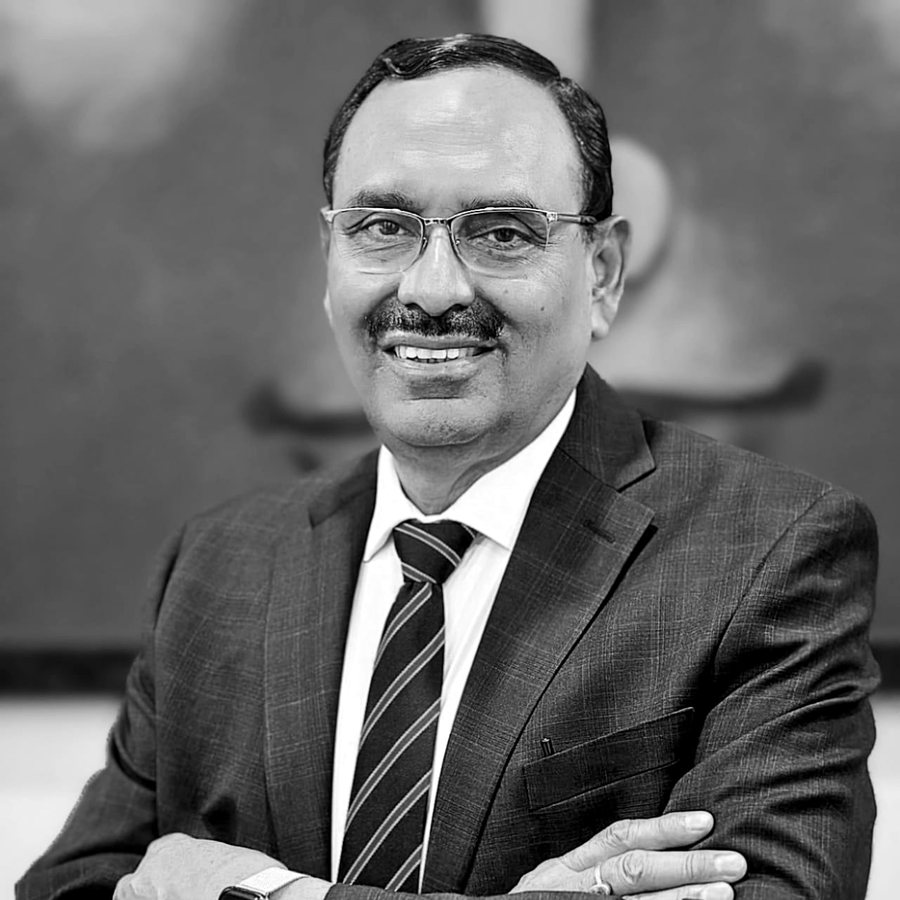
Vijai Pratap Singh
Forty-two years a judge: thirty-six in the courts of Uttar Pradesh, from Munsif Magistrate to District and Sessions Judge, and six on the Benches of the National Company Law Tribunal and its Appellate Tribunal. Mr V.P. Singh now practises before the Supreme Court and the High Courts, sits as an arbitrator and mediator, and writes on the law.
A career in the law
1978 – 1979
Allahabad
Mr Singh read law at Allahabad University and graduated in 1978. Within a year he had cleared the Uttar Pradesh Provincial Civil Service (Judicial) examination, and in 1979 he took his seat as a Munsif Magistrate, one of the youngest officers to enter the State’s judiciary.
1979 – 2015
Thirty-six years in the courts of Uttar Pradesh
The district courts are where most of India’s litigation begins and ends, and Mr Singh spent thirty-six years in them. He began in the Munsif’s court, hearing civil suits and criminal cases at first instance, and rose through each rank of the service into the Higher Judicial Services.
As District and Sessions Judge he headed the judiciary of several districts, among them Agra and Kanpur. The office joins the highest civil and criminal jurisdiction in a district to the administration of all its courts: sessions trials, civil appeals, and the supervision of every judge who sits below.
On deputation he presided as Member of the Sales Tax Tribunal at Meerut, which added tax adjudication to his experience. He superannuated from the Uttar Pradesh Higher Judicial Services in 2015, with the command of civil and criminal law that comes only from decades of trial and appellate work.
2016 – 2019
A founding Member of the National Company Law Tribunal
Retirement lasted a year. In 2016 the National Company Law Tribunal was constituted, and Mr Singh was appointed Member (Judicial) in its first batch of Members.
It was an unusual moment to take the Bench. The Insolvency and Bankruptcy Code had been enacted that same year and there were no precedents under it. Questions that are settled law today, on when a company may be admitted into insolvency, on the powers of creditors and resolution professionals, on what a resolution plan may and may not do, came before the first Benches as open questions and had to be answered from the statute alone.
He served as Judicial Member and Head of Department at Kolkata, Allahabad and Mumbai. In those years he heard and decided thousands of matters across the whole of the Tribunal’s jurisdiction: insolvency applications by banks, financial institutions and trade creditors; resolution plans and liquidations; petitions of oppression and mismanagement; and schemes of merger, amalgamation and arrangement.
The insolvencies of Jaypee Infratech and Sterling Biotech, two of the most closely followed proceedings of the Code’s early years, were among those heard before him.
2019 – 2022
Elevation to the Appellate Tribunal
In 2019 Mr Singh was elevated to the National Company Law Appellate Tribunal as Member (Technical). The Appellate Tribunal hears appeals from every Bench of the NCLT in the country.
He sat on its Benches at New Delhi and at Chennai until 2022, when he retired at the age of 67. The matters that came before him across the two Tribunals include, besides those already named, the proceedings concerning Antrix Corporation and Devas Multimedia, Dewan Housing Finance Corporation and Infrastructure Leasing & Financial Services.
More than 200 of his judgments are reported in the law journals. Several did more than decide the case at hand: positions they took were later written into the Insolvency and Bankruptcy Code itself, by amendment.
2022 – present
At the Bar
Mr Singh did not retire a second time. Since 2022 he has practised as an advocate before the Supreme Court of India and the High Courts, and he is consulted on company and insolvency law, where he now advises on provisions he once interpreted from the Bench.
His practice extends to commercial disputes and intellectual property, and to real estate law under the Real Estate (Regulation and Development) Act, a subject on which he has also written.
He also sits as a neutral. He is empanelled as an arbitrator with the National Highways Authority of India and has conducted numerous arbitrations, and he is a Mediator certified by the Supreme Court.
In 2026 he joined the Member Committee of the National Stock Exchange of India as an Independent External Professional. He is the Managing Partner of VPS Law Associates and a Partner of Revera Legal, New Delhi.
Throughout
The writer
Between court and consultation, Mr Singh writes. His columns and op-eds, on insolvency, company law, the tribunals and the judiciary itself, are published in SCC Times, Bar & Bench and LiveLaw, and are collected on this website.
His opinions on questions of law and regulation are also carried frequently in the financial and economic press, including the Financial Times, Mint and Moneycontrol.
- Trial Judge
- District & Sessions Judge
- Tribunal Member
- Appellate Member
- Advocate
- Arbitrator
- Mediator
- Author
- Qualifications
- Graduate in Law, Allahabad University, 1978
- Enrolled with
- Bar Council of Uttar Pradesh
- Year of enrolment
- 1978
- Courts
- Supreme Court of India and the High Courts
- Also
- Arbitrator on the panel of the National Highways Authority of India; Mediator certified by the Supreme Court
- Fields
- Company law; insolvency; commercial law and intellectual property; real estate and RERA; arbitration
Writing
Columns and op-eds
Mr Singh writes on insolvency, company law, tribunals and the judiciary. His columns and op-eds appear in SCC Times, Bar & Bench and LiveLaw, and his opinions are carried frequently in the financial press, including the Financial Times, Mint and Moneycontrol.
-
Column · Bar & Bench
The Charity Commissioner as Kingmaker: Caveats, Freezes and the Battle for Tata Sons
Public Trusts & Corporate Control
-
Op-Ed · SCC Times
Finality Against the Stay: Settlement Finality, Clearing-Corporation Priority and the Insolvency Moratorium After the Securities Markets Code
Insolvency & Securities Markets
-
Op-Ed · SCC Times
Restraint, Rights and Remedy: Restrictive and IP Covenants in Service Contracts at the Crossroads of the Contract Act, the Competition Act and the Specific Relief Act
Contract & Competition Law
-
Op-Ed · SCC Times
Incentive or Windfall? Reconsidering the Resolution Professional’s “Success Fee” under Regulation 34-B
Insolvency & Bankruptcy
-
Column · Bar & Bench
Resolution in Name, Recovery in Fact: The Operational Creditor and Section 9
Insolvency & Bankruptcy
-
Article · LiveLaw
Can Tata Sons Restructure Its Way Past RBI’s Listing Mandate?
Corporate & Financial Regulation